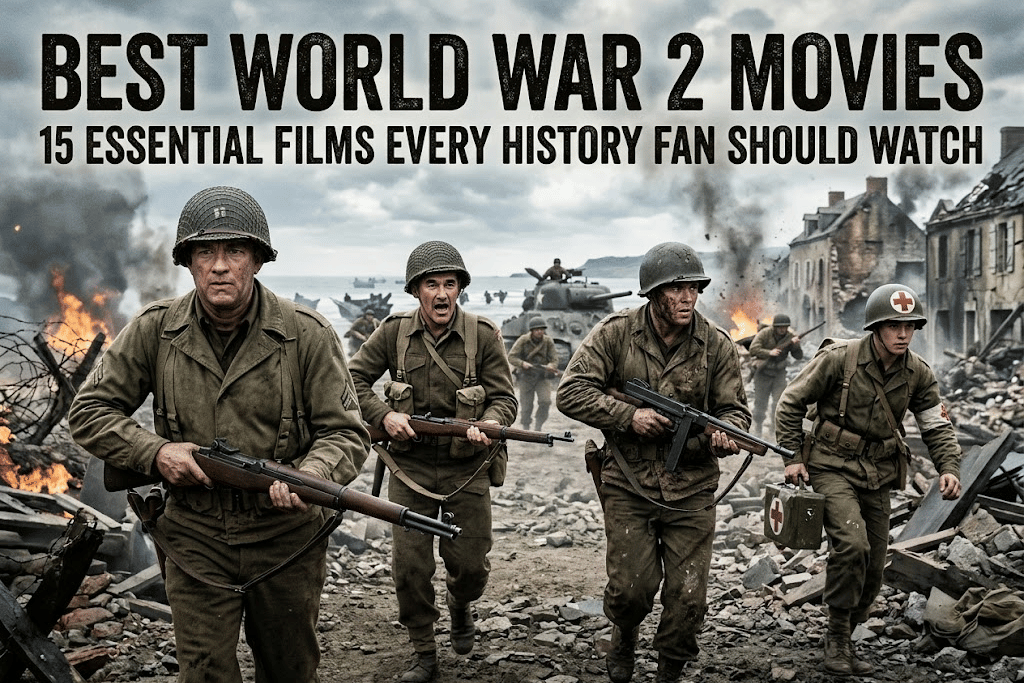
The best world war 2 movies do more than recreate famous battles. They show civilians, soldiers, prisoners, resistance fighters, and survivors facing impossible choices. This ranked list combines major American favorites with essential international films.
Quick answer: The strongest starting trio is Schindler’s List, Saving Private Ryan, and Das Boot. Together, they cover the Holocaust, Allied ground combat, and the German submarine war. Choose Saving Private Ryan for combat intensity or Schindler’s List for historical and emotional weight.
| Rank | Movie | Year | Best For |
|---|---|---|---|
| 1 | Schindler’s List | 1993 | Holocaust drama |
| 2 | Saving Private Ryan | 1998 | Ground combat |
| 3 | Das Boot | 1981 | Submarine warfare |
| 4 | Casablanca | 1942 | Romance and resistance |
| 5 | Come and See | 1985 | Civilian devastation |
| 6 | The Pianist | 2002 | Survival under occupation |
| 7 | Grave of the Fireflies | 1988 | Civilian tragedy |
| 8 | The Bridge on the River Kwai | 1957 | POW drama |
| 9 | Letters from Iwo Jima | 2006 | Japanese perspective |
| 10 | Dunkirk | 2017 | Evacuation and suspense |
| 11 | The Great Escape | 1963 | POW escape story |
| 12 | Life Is Beautiful | 1997 | Family and the Holocaust |
| 13 | Patton | 1970 | Military leadership |
| 14 | Tora! Tora! Tora! | 1970 | Pearl Harbor |
| 15 | Inglourious Basterds | 2009 | Alternate-history entertainment |
How We Ranked the Best World War 2 Movies
This ranking weighs filmmaking quality, historical perspective, influence, and usefulness for modern viewers. It also considers how consistently each film appears in major current recommendations. Recent Time Out and IMDb lists show substantial agreement around several titles here.
The list does not treat historical accuracy as the only measure of quality. Some films recreate documented events closely, while others use fiction to explore wartime themes. That distinction matters when choosing what to watch.
1. Schindler’s List
Steven Spielberg’s Schindler’s List follows German businessman Oskar Schindler during the Holocaust. Its black-and-white photography keeps the story restrained despite its devastating subject. The film remains one of cinema’s most widely recognized Holocaust dramas.
- Pros: Powerful performances, historical importance, unforgettable visual storytelling.
- Cons: More than three hours long and emotionally difficult.
2. Saving Private Ryan
Saving Private Ryan begins with Allied forces landing in Normandy, then follows a dangerous rescue mission. Its combat scenes emphasize confusion, fear, noise, and physical vulnerability. Historians have also discussed its influential approach to depicting battlefield realism.
- Pros: Immersive battle sequences, strong ensemble cast, accessible story.
- Cons: Graphic violence makes it unsuitable for some viewers.
3. Das Boot
Wolfgang Petersen’s Das Boot follows a German U-boat crew during the Battle of the Atlantic. Much of the tension comes from confinement rather than large battlefield scenes. The result feels closer to a survival thriller than a conventional heroic war story.
- Pros: Claustrophobic atmosphere, unusual perspective, sustained tension.
- Cons: Different cuts have different runtimes, which can confuse first-time viewers.
4. Casablanca
Casablanca places romance, political compromise, and resistance inside wartime French Morocco. Humphrey Bogart and Ingrid Bergman give the story an intimacy most combat films lack. Its World War II setting shapes every major decision without dominating every scene.
- Pros: Concise storytelling, memorable characters, highly accessible classic.
- Cons: Viewers seeking battlefield action will find little.
5. Come and See
Soviet film Come and See follows a Belarusian teenager through the destruction caused by Nazi occupation. The movie presents war as psychological collapse rather than adventure. Its perspective also expands this list beyond familiar American and Western European stories.
- Pros: Distinctive perspective, forceful filmmaking, uncompromising anti-war message.
- Cons: Its disturbing imagery can be extremely difficult to watch.
6. The Pianist
The Pianist follows Polish-Jewish musician Władysław Szpilman during the destruction of Warsaw’s Jewish community. Survival depends more on chance and endurance than battlefield heroics. Adrien Brody’s central performance keeps the enormous historical tragedy personal.
- Pros: Focused personal story, restrained performances, strong sense of place.
- Cons: Contains prolonged scenes of persecution and violence.
7. Grave of the Fireflies
Grave of the Fireflies shows the war through two Japanese children struggling to survive. The animation creates no emotional distance from their hunger, isolation, and loss. It is especially valuable for viewers seeking civilian perspectives from the Pacific War.
- Pros: Intimate civilian viewpoint, beautiful animation, exceptional emotional impact.
- Cons: Its tragic tone makes it difficult to watch casually.
8. The Bridge on the River Kwai
David Lean’s The Bridge on the River Kwai centers on Allied prisoners held by Japanese forces. The story examines duty, pride, obedience, and the strange psychology captivity can create. Its central conflict becomes increasingly complicated as personal honor clashes with military objectives.
- Pros: Strong character writing, large-scale filmmaking, moral complexity.
- Cons: It should not be treated as a literal reconstruction of every historical detail.
9. Letters from Iwo Jima
Clint Eastwood’s Letters from Iwo Jima views the famous Pacific battle mainly through the eyes of the Japanese defenders. That choice creates a different experience from many American-made Pacific War films. The soldiers appear as individuals facing fear, duty, and almost certain defeat.
- Pros: Rare viewpoint, restrained direction, strong human focus.
- Cons: Deliberate pacing may feel slow for action-focused viewers.
10. Dunkirk
Christopher Nolan’s Dunkirk follows the 1940 evacuation from land, sea, and air. Dialogue stays limited because visual tension carries much of the story. The structure makes evacuation itself feel like an urgent survival problem.
- Pros: Strong sound design, unusual structure, constant tension.
- Cons: Character development is intentionally thinner than many traditional war dramas.
11. The Great Escape
The Great Escape turns a real prisoner escape effort into a polished ensemble adventure. Its characters plan tunnels, forge documents, and devise disguises and routes through occupied Europe. Steve McQueen’s performance helped make the movie especially enduring for American audiences.
- Pros: Entertaining ensemble, strong pacing, memorable escape sequences.
- Cons: Several characters and events were changed for dramatic effect.
12. Life Is Beautiful
Roberto Benigni’s Life Is Beautiful mixes comedy, family drama, and Holocaust tragedy. The father uses imagination to shield his young son from the surrounding horror. That tonal choice remains emotionally effective but also makes the film different from more literal historical dramas.
- Pros: Distinctive storytelling, memorable central relationship, approachable first half.
- Cons: Its tonal approach will not work equally well for every viewer.
13. Patton
Patton focuses on American General George S. Patton and his leadership on the battlefield. The film explores ambition and personality as much as military strategy. George C. Scott’s performance gives the movie its commanding center.
- Pros: Strong lead performance, large battle scenes, leadership-focused perspective.
- Cons: The character study sometimes outweighs broader wartime context.
14. Tora! Tora! Tora!
Tora! Tora! Tora! reconstructs the events surrounding the attack on Pearl Harbor from American and Japanese viewpoints. Its procedural approach emphasizes planning, communication failures, and military decisions. Accuracy discussions often cite it as a strong choice for viewers interested in historical detail.
- Pros: Dual perspective, careful military detail, valuable Pearl Harbor context.
- Cons: Its methodical pace may feel distant compared with modern war films.
15. Inglourious Basterds
Quentin Tarantino’s Inglourious Basterds uses Nazi-occupied Europe for a deliberately fictional revenge story. The film makes no attempt to reproduce the war’s historical outcome. Instead, it uses suspense, dark humor, and alternate history for entertainment.
- Pros: Memorable dialogue, high tension, distinctive alternate-history concept.
- Cons: It is a poor choice for anyone seeking historical accuracy.
Which World War II Movie Should You Watch First?
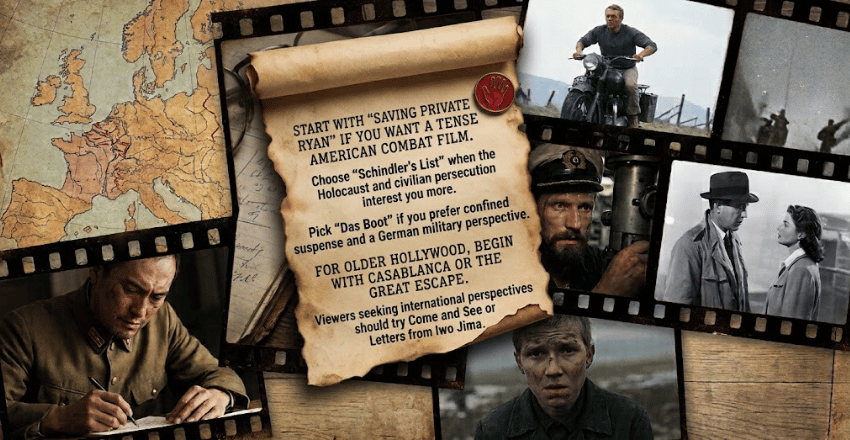
Start with Saving Private Ryan if you want a tense American combat film. Choose Schindler’s List when the Holocaust and civilian persecution interest you more. Pick Das Boot if you prefer confined suspense and a German military perspective.
For older Hollywood, begin with Casablanca or The Great Escape. Viewers seeking international perspectives should try Come and See or Letters from Iwo Jima. Animation fans should not overlook Grave of the Fireflies because of its format.
Readers exploring cinema beyond this period can browse Writina’s broader Entertainment section for more film coverage. Writina also has film-focused career profiles on Antonio Banderas and his movies and Dave Bautista’s acting career. Those pages offer useful next stops for readers interested in actors and Hollywood careers.
What Is the Most Historically Accurate WWII Movie?
No single movie is universally accepted as the most accurate. Tora! Tora! Tora! and Das Boot frequently appear in discussions about historically credible war filmmaking. The Longest Day and Dunkirk also receive regular recognition for reconstructing real operations.
Accuracy still depends on what a viewer wants measured. A film may reproduce equipment carefully while compressing people, timelines, or events. Historical movies should therefore work as starting points rather than replacements for documentary evidence.
Why These Films Still Matter
World War II lasted only several years, yet its consequences reshaped governments, borders, families, and popular culture. Film gives viewers access to perspectives a single battlefield story can’t capture. The strongest movies also resist reducing the conflict to explosions and victories.
That variety explains why no single selection works for every viewer. A Holocaust drama serves a different purpose from a submarine thriller or POW escape movie. Watching several perspectives gives a broader picture than choosing one supposed definitive film.
Frequently Asked Questions
What are the best World War II movies to watch first?
Start with Schindler’s List, Saving Private Ryan, and Das Boot. The three films offer sharply different perspectives on the conflict. They cover persecution, Allied combat, and German submarine warfare without feeling repetitive.
What is the best WWII movie about D-Day?
Saving Private Ryan is the most familiar starting point for American viewers interested in D-Day. Its opening depicts the Normandy landings before the story becomes a fictional rescue mission. The Longest Day is another useful choice for a broader operational view.
Is Saving Private Ryan historically accurate?
Its central rescue mission is fictionalized, so the movie is not a documentary. Its combat presentation received substantial attention for realism after release. Historians have particularly discussed the movie’s depiction of battlefield experience and violence.
Which WWII film shows the German perspective?
Das Boot is one of the strongest options for that perspective. It follows a German U-boat crew instead of Allied protagonists. Downfall also provides a German-centered story, though it focuses on Hitler’s final days.
What WWII movie shows the Japanese perspective?
Letters from Iwo Jima is an excellent starting point. It follows Japanese soldiers defending Iwo Jima rather than American attackers. Tora! Tora! Tora! also divides attention between Japanese and American planning around Pearl Harbor.
Are fictional World War II films worth watching?
Yes, as long as you know when a film is intentionally fictional. Inglourious Basterds rewrites history and never presents itself as a factual account of the war’s end. It works better as alternate-history cinema than historical instruction.
The Final Verdict
Schindler’s List earns the top position because its filmmaking and subject carry extraordinary historical weight. Saving Private Ryan is the strongest first choice for viewers focused on American combat. Das Boot completes the top three with a tense perspective rarely centered in Hollywood films.
No ranking can represent every theater, country, or experience from the conflict. Use this list as a starting watchlist rather than a final historical syllabus. Pick three contrasting films first, then follow the perspective that interests you most.