
Direct answer: Reasonable suspicion is the Fourth Amendment standard that allows police to briefly detain someone when specific, objective facts suggest that criminal activity may be occurring. It requires more than a hunch but less than probable cause. A frisk requires an additional safety basis: the officer must reasonably suspect that the person is armed and dangerous.
The rule comes from decades of Fourth Amendment cases addressing how far police may go before an encounter becomes an arrest or a broader search.
| Key question | Practical answer |
|---|---|
| Constitutional basis | Fourth Amendment protection against unreasonable searches and seizures |
| Leading case | Terry v. Ohio, decided June 10, 1968 |
| Reasonable suspicion | Specific, objective facts and rational inferences, not a bare hunch |
| Compared with probable cause | Lower evidentiary threshold and narrower police authority |
| Investigative stop | Usually brief and tied to confirming or dispelling the officer’s concern |
| Protective frisk | Requires grounds to believe the person may be armed and dangerous |
| Traffic-stop limit | Police generally cannot add time for an unrelated investigation without an independent basis |
| Identification | Duties can depend on state law and the type of encounter |
Key Takeaways
- Police need objective, articulable facts before making an investigative detention.
- A stop and a weapons frisk are separate actions with separate legal requirements.
- Courts consider the whole situation rather than relying on one fact in isolation.
- Probable cause is a higher standard and supports more intrusive police action.
- State law can affect identification requirements during a valid stop.
Readers researching related legal concepts can also browse Writina’s Law section.
What Reasonable Suspicion Means Under the Fourth Amendment
The Fourth Amendment protects people from unreasonable government searches and seizures. Not every conversation with an officer is a seizure. The constitutional question becomes more significant when an officer restricts a person’s freedom to leave.
In Terry v. Ohio, decided in 1968, the Supreme Court approved a brief investigative stop based on specific observations. A detective watched two men repeatedly walk past a store and look inside. Their behavior supported the officer’s belief that they might be preparing to commit a robbery. The full opinion is available from Cornell Law School’s text of Terry v. Ohio, 392 U.S. 1 (1968).
That decision created what is commonly called a Terry stop.
The officer doesn’t need enough evidence to make an arrest at that stage. However, the officer does need objective facts that can be clearly articulated. A vague feeling that somebody “looks suspicious” isn’t enough.
Courts review those facts together. This is known as the totality of the circumstances approach.
How a Police Encounter Can Change From a Conversation to an Arrest
The legal authority available to an officer depends on what the officer does.
| Police encounter | Required legal basis | What it generally permits |
| Consensual conversation | No individualized basis required | Officer may approach and ask questions; the person is generally free to leave |
| Investigative detention | Specific, articulable facts suggesting criminal activity | Brief detention and focused investigation |
| Protective frisk | Reasonable belief that the detained person is armed and dangerous | Limited pat-down for weapons |
| Arrest | Probable cause | Custodial arrest; any accompanying search must fit applicable Fourth Amendment rules |
The second and third rows often cause confusion.
An officer who has grounds for an investigative detention does not automatically gain the authority to frisk the person. A weapons search requires its own safety justification.
Terry describes the frisk as a protective measure rather than a general search for evidence. Its purpose is to address a reasonable concern that the person may be armed and dangerous.
How the Stop Standard Differs From Probable Cause
Probable cause requires a stronger factual basis. An arrest generally means that the circumstances support a reasonable belief that the person committed or is committing an offense.
For a search warrant, the question is whether there is a fair probability that evidence of a crime will be found in the place to be searched.
A Terry detention confers less authority because it rests on a lower threshold.
Consider an officer who watches two people repeatedly inspect a closed business, confer, separate, and return. Those observations might support a temporary investigation before the officer has sufficient evidence to make an arrest.
The facts discovered during that investigation can change the situation. The officer’s concern may disappear, ending the stop. New evidence may instead establish probable cause.
What Facts Can Support an Investigative Stop?
There is no universal checklist that turns one fact into a lawful detention.
Courts look at what the officer knew at the moment of the stop. Relevant considerations may include observed conduct, reliable witness information, evasive behavior, location, timing, and reasonable inferences based on the circumstances.
A location associated with frequent crime isn’t enough by itself. In Illinois v. Wardlow, the Supreme Court said location could be considered as part of the context. The defendant’s unprovoked flight after seeing police also contributed to the analysis.
That doesn’t mean running, nervousness, or being in a particular neighborhood automatically proves criminal activity. Courts consider how the facts interact.
The same principle matters in public-order encounters. Conduct that seems odd may be innocent, while specific actions can provide additional context. For background on another public-order issue, see Writina’s disorderly conduct overview.
Anonymous Tips Can Be Enough, but Reliability Matters
A tip to police isn’t automatically reliable merely because it accurately describes someone’s clothing, vehicle, or location.
In Florida v. J.L., an anonymous caller said a young man at a bus stop had a gun. The caller described him but supplied no predictive information or other evidence showing knowledge of illegal activity.
The Supreme Court held that a bare, anonymous report was insufficient to support a stop and frisk. The tip needed reliability concerning the alleged wrongdoing, not merely the person’s identity.
A later case shows why context matters.
In Navarette v. California, a 911 caller reported that a specific truck had run her off the road. The Court considered the caller’s claimed eyewitness knowledge, the timing of the report, the vehicle details, and characteristics of the 911 system. Taken together, those factors provided enough support for the traffic stop.
The lesson is simple: the content and reliability of a tip matter together.
Traffic Stops Cannot Be Extended Indefinitely
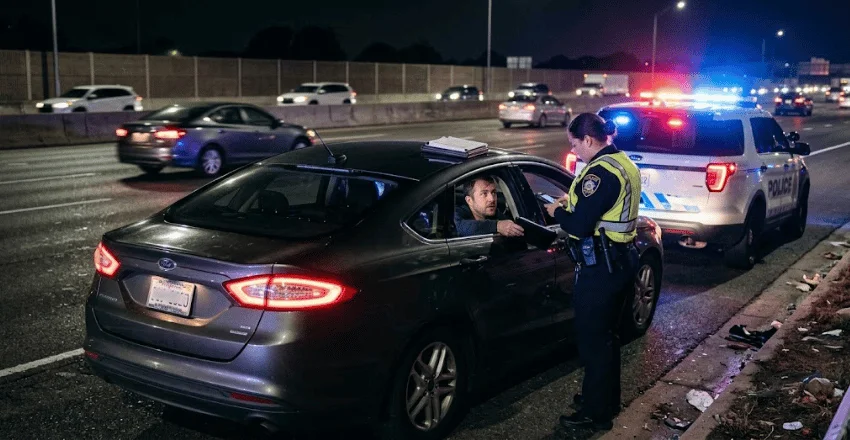
A traffic stop has its own purpose. An officer may address the traffic violation and perform ordinary safety-related tasks associated with the stop.
The Supreme Court addressed this time limit in Rodriguez v. United States. There, police completed the traffic-related work and then prolonged the detention for a dog sniff.
The Court held that officers can’t extend a completed traffic stop for that separate investigation without an independent legal basis. Even a relatively short additional delay can matter if it extends the seizure beyond its lawful mission.
There isn’t a single nationwide rule setting a fixed detention time, such as exactly 15 minutes. Courts instead examine the stop’s purpose, what officers were doing, and whether they pursued the investigation with reasonable diligence.
Do You Have to Give Police Your Name?
The answer can depend on state law and on whether the encounter is voluntary or a valid detention.
An officer may generally ask for identification during a consensual encounter. Asking for identification does not, by itself, transform the conversation into a seizure.
Some states have stop-and-identify laws.
In Hiibel v. Sixth Judicial District Court of Nevada, the Supreme Court upheld Nevada’s requirement that a person disclose his name during a valid Terry stop. The decision did not create a nationwide rule requiring everyone approached by police to provide identification.
Drivers are also subject to separate licensing requirements during traffic stops.
Because state statutes differ, a person facing an actual criminal case should check the law in the jurisdiction where the encounter occurred.
What Should You Do During an Investigative Detention?
A few practical questions can clarify the encounter without escalating it.
| Situation | Practical response |
| You’re unsure whether the conversation is voluntary | Calmly ask, “Am I free to leave?” |
| Officer says you are detained | Don’t physically resist the detention |
| Police request consent to search | You can clearly state that you don’t consent if you don’t wish to give permission |
| Officer asks for identification | Consider state law and whether you are driving |
| Encounter becomes an arrest or custodial interrogation | Clearly ask for a lawyer before answering substantive questions |
| You believe the stop was unlawful | Record details afterward and raise the issue through legal channels rather than physically resisting |
What Happens if the Stop Lacked a Legal Basis?
An unlawful detention can affect evidence collected afterward.
In a criminal case, a defense lawyer may file a motion to suppress evidence obtained in violation of constitutional rights. The exclusionary rule can prevent certain unlawfully obtained evidence from being used at trial, although several exceptions may apply.
The details matter. Courts may examine officer reports, body-camera footage, dispatch records, witness statements, and the exact timeline of events.
A suppression issue can also be triggered when the seizure begins. A conversation that started voluntarily may later become a detention, so even a few seconds in the timeline can change the analysis.
For broader reading about how disputes, evidence, and court proceedings are handled outside criminal cases, Writina also has a civil litigation guide.
The Bottom Line
A brief police detention falls between a voluntary conversation and an arrest. That middle ground gives officers room to investigate specific suspicious circumstances, but it does not give them unlimited authority.
The facts must support the intrusion, and a weapons frisk requires its own independent basis in safety. Traffic stops also remain tied to their lawful purpose. If a real stop led to an arrest, search, or criminal charge, write down the timeline while it is fresh. Then speak with a criminal defense lawyer licensed in the state where the encounter occurred. Small factual differences can determine whether a court finds the detention constitutional.
Frequently Asked Questions
An officer sees two people repeatedly walk past a closed store, peer through its windows, confer, and repeat the pattern. Those observations can support a brief investigation by providing an objective basis for suspecting planned criminal activity. Terry v. Ohio involved similar observations.
No. A valid investigative detention doesn’t automatically permit a pat-down. Police need an additional reasonable basis to believe that the person may be armed and dangerous. The frisk is limited by its protective purpose.
Generally, location alone isn’t enough. The Supreme Court has treated location as one of many contextual factors. Individualized behavior and the full circumstances still matter.
There is no fixed nationwide number of minutes. Its duration must remain reasonably related to the reason for the stop and the investigation being conducted. A traffic stop cannot be prolonged for an unrelated dog sniff without an independent basis.
Sometimes. A bare accusation from an unknown caller may lack sufficient reliability, while a detailed, timely eyewitness 911 report can carry more weight. Courts examine both what the caller reported and why police could reasonably trust the report.