
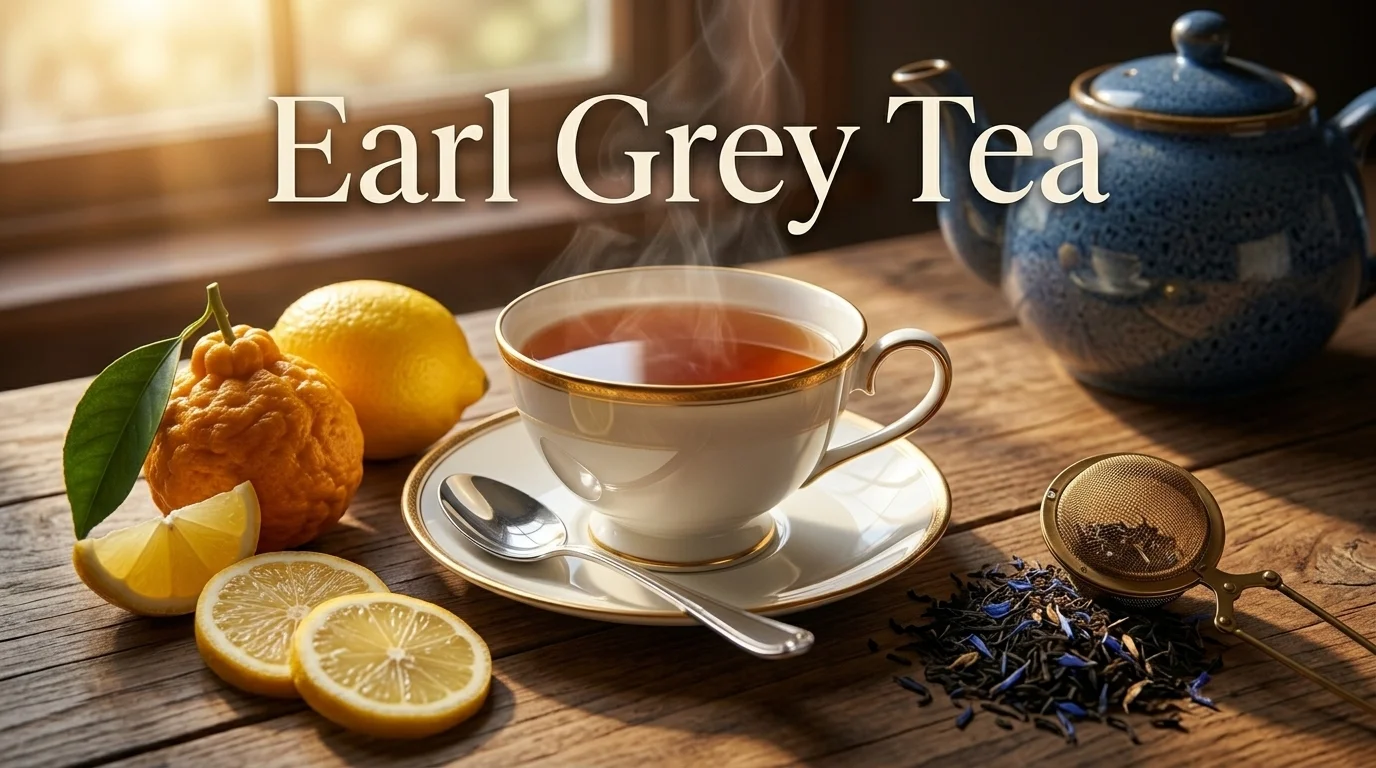
Type Earl Grey Tea into a search box, and you land on a black tea scented with bergamot. The spelling is American. The tea is British, and most boxes print it as Earl Grey. Earl Grey is black tea carrying oil pressed from the rind of the bergamot orange, a bumpy green citrus that grows mostly in southern Italy. Blenders add the oil after the leaf finishes processing, so no juice, no pulp, and no dried peel ever reaches your cup.
Earl Grey Tea at a glance
Here is the whole thing in one table, before we get into the parts that matter at the shop.
| Detail | What you get |
|---|---|
| Base leaf | Black tea, usually Ceylon, Assam or a China blend |
| Flavoring | Oil from the bergamot rind |
| The fruit | Citrus bergamia, grown mostly in Calabria, Italy |
| Aroma | Sharp peel with a soft floral edge behind it |
| Water | Just off the boil, around 208°F |
| Steep time | 3 to 4 minutes |
| Milk | Works on a strong base, muddies a delicate one |
Key takeaways
- The American spelling and the British one name the same drink.
- Bergamot is a citrus fruit, not a flower or a herb.
- The flavor comes from cold-pressed oil taken from the rind, never from juice or dried fruit pieces.
- Calabria in southern Italy grows about 90 percent of theworld’ss bergamot oil supply.
- Good tea smells of fresh peel. Cheap tea smells of candy.
- Look for bergamot oil on the ingredient list rather than the words natural flavoring.
Earl gray or Earl Grey? Two spellings, one tea
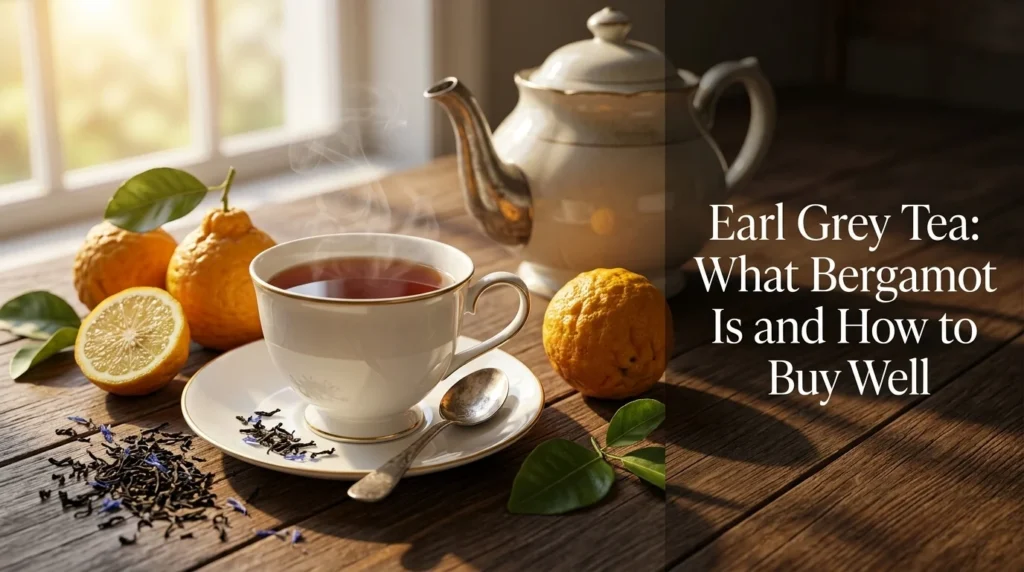
Charles, the 2nd Earl Grey, ran Britain as prime minister in the 1830s, and the blend picked up his title somewhere along the way. Nobody can prove how. American keyboards and American habit pulled the second word toward a simpler spelling, and both versions now sit side by side in search boxes.
Nobody owns the name either. No blender ever registered it as a trademark, which is why any company can print it on a box. That freedom explains how two tins with identical names can taste nothing alike.
Bergamot is a citrus, not a flower.
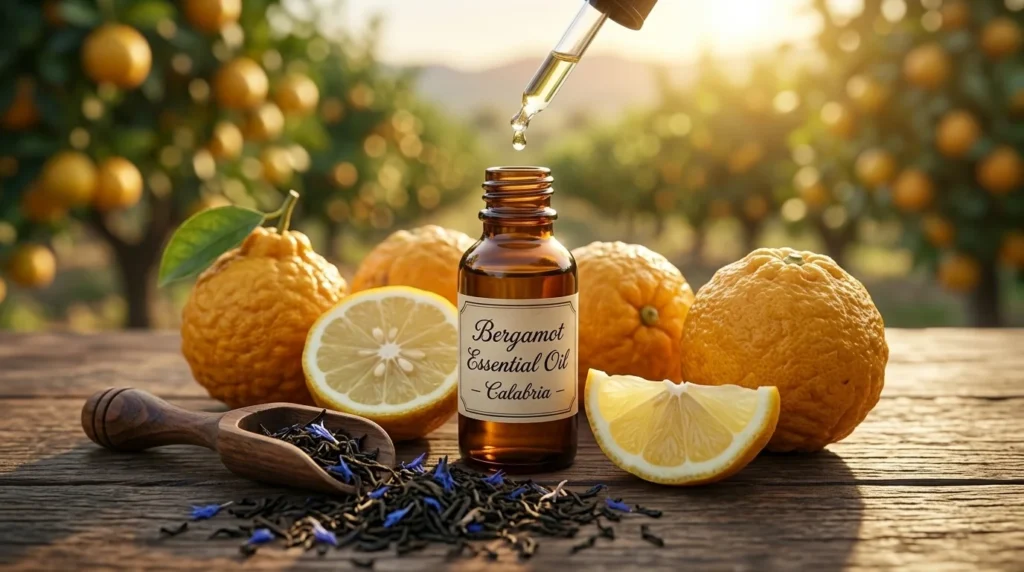
Bergamot is a fruit. It hangs on a small tree, about the size of an orange, with a rind that ripens from deep green to yellow. Botanists file it as Citrus bergamia and treat it as a cross between a bitter orange and a lemon or citron.
Almost all of it comes from one strip of coast. Calabria, at the toe of southern Italy, grows roughly 90 percent of the world bergamot oil supply, and growers who plant the tree elsewhere rarely get the same crop.
You would not enjoy eating one.
Flesh this sour and bitter never makes it to a breakfast table, and nobody presses it for juice. Its whole value sits in the peel, which holds the aromatic oil that gives this tea its smell, and growers pick the fruit in winter when that oil runs strongest.
How the oil gets onto the leaf
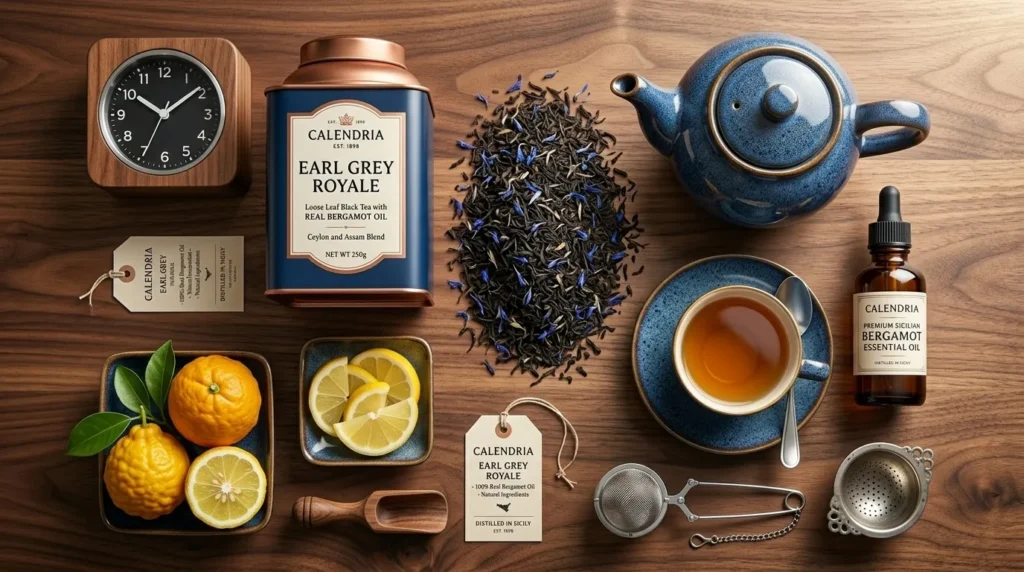
Workers cold-press the rind, squeezing oil out without heat. Heat would burn off the top notes that make the aroma recognizable in the first place. It takes a great deal of fruit to fill one small bottle, which is why the real thing carries a real cost.
- Spraying: the blender mists diluted oil over finished black leaf in a rotating drum.
- Tumbling: leaf and oil turn together until the scent settles evenly through the batch.
- Layering: a few makers rest the leaf beside the oil and let it take the aroma slowly.
None of that adds fruit.
What you buy is black tea wearing a citrus perfume, and the quality of that perfume decides the cup.
Real bergamot oil against synthetic flavoring
Earl Grey: Turn the box over. An honest blend names bergamot oil, or bergamot essential oil, in the ingredient list. A cheaper one hides behind natural flavoring, and that phrase covers a lot of ground.
Synthetic bergamot flavoring gets built from a short list of aroma chemicals, mostly linalyl acetate and linalool. It smells loud, flat, and one-note, then fades within two minutes of hitting hot water. Real oil carries hundreds of compounds, so the scent moves as you drink: bright peel first, then something soft and faintly bitter underneath.
Label wording gets argued over in public, as the Simply Orange labeling complaint showed, and tea sits under the same rules as juice.
Read the ingredients. Front-of-box wording is advertising.
Lady Grey, French and Russian: the other blends
The name attaches to a family of blends, not one recipe. Here is what the common variants actually contain.
| Blend | What gets added | How it tastes |
|---|---|---|
| Lady Grey | Lemon peel, orange peel, cornflower petals | Lighter, softer, less perfumed |
| French Earl Grey | Rose petals, sometimes hibiscus | Floral and slightly sweet |
| Russian Earl Grey | Citrus peel with lemongrass | Brighter and grassy, less floral |
| Earl Grey Crème | Vanilla, sometimes lavender | Round and dessert-like |
| London Fog | Steamed milk and vanilla syrup | A drink you build, not a blend you buy |
How to spot a cheap blend before you buy
Smell the dry leaf first. You can do it through the packet at a shop, or the second you crack the seal at home, and it tells you more than any label.
- Look at the leaf. A whole or broken leaf beats dust and fannings, the tiny particles that fill most supermarket tea bags.
- Smell for peel, not candy. Fresh rind reads green and a little bitter. Synthetic scent reads like lemon dish soap.
- Read the leaf grade. Marks such as OP or FBOP mean the maker kept the leaf large instead of grinding it down.
- Check the ingredient list. Bergamot oil named outright beats a vague flavoring line every time.
- Brew one cup plain. If the citrus disappears after two minutes, the oil was thin to begin with.
Price helps a little, though not much. Loose leaf mostly runs $8 to $25 a tin in American shops, and plenty of expensive tins hold ordinary leaf under a loud scent. Your nose costs nothing and works better.
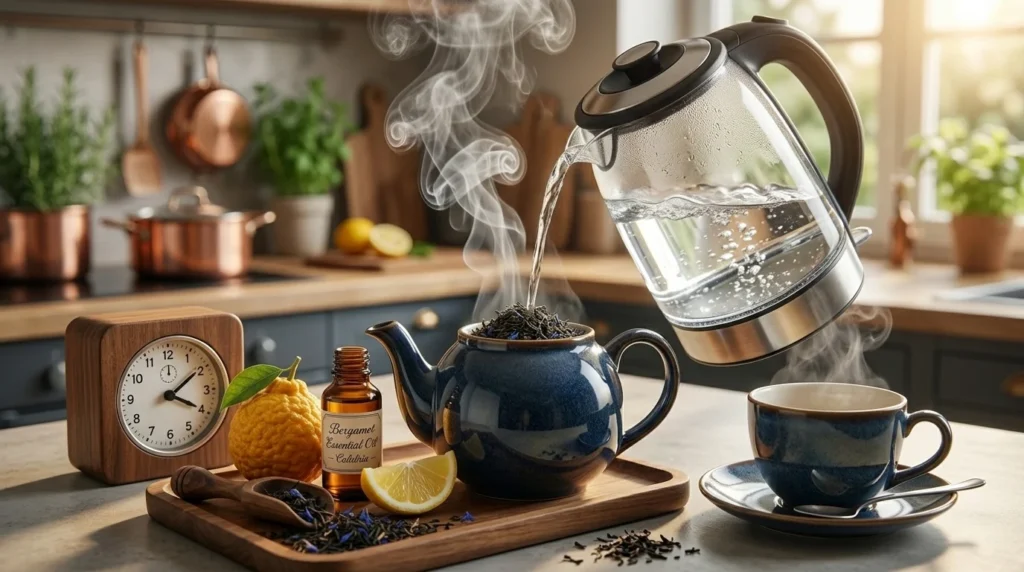
Brewing it so the citrus survives..
Bergamot oil is delicate. Boiling water flattens it, and a long steep pulls out tannin that buries whatever survives the heat.
- Heat fresh water to about 208°F, just under a rolling boil.
- Measure one rounded teaspoon of leaf for every 8 fl oz.
- Steep 3 to 4 minutes, then lift the leaves out completely.
- Taste it before you add anything at all.
- Pour milk only into a base strong enough to carry it.
Water quality moves the flavor more than most people expect. Hard water dulls the peel note and leaves an oily film on the surface, so a filter jug helps; our water softener and filter guide covers the longer-term fix.
Iced works beautifully. Brew it double strength, chill it, then pour it over ice with a squeeze of fresh lemon. If you build a lot of drinks at home, our juicers buying guide covers the machines worth the counter space.
Frequently asked questions
No. It contains oil taken from the fruit peel, and nothing else from the plant. You will not find pieces of citrus in a classic blend, though some flavored versions add dried peel for looks.
Sharp citrus over a malty black base, with a soft floral note behind it. A good one tastes like fresh peel. A weak one tastes like lemon candy and vanishes fast.
Lady Grey adds lemon peel, orange peel, and cornflower to a lighter black base. The bergamot is dialed back, so the cup reads gentler and more lemony. Twinings created it in the 1990s and holds the name.
Yes, on a strong Assam or Ceylon base. Milk softens tannin and rounds the citrus. On a delicate China base,e it flattens the aroma, so taste the cup plain first and decide from there.
Usually, yes. Bigger leaf holds the oil longer and releases it more slowly, which is the whole point of the blend. Pyramid bags with visible leaf sit in between and cost less trouble.
Your next step is small. Turn the next box over in the aisle, read the ingredient line before you look at the price, and buy the one that names its oil.