

Ranking a clinic is not the same job as ranking a plumber. Two rulebooks apply at once. Google grades medical pages harder than almost anything else it indexes, and federal privacy and advertising law decides what you may publish and promise. Healthcare SEO lives in that overlap, and most agency checklists cover only half of it.
Short answer: ranking a medical practice means proving expertise, and page tuning alone will not do it. Google treats health topics as Your Money or Your Life, so it looks for named clinicians behind the words. Local map results settle most patient searches. Privacy and advertising rules then limit what you can claim and track.
What changes the moment a website is a medical one
Crawling and indexing work the same way everywhere. The constraints do not.
| Who writes it | Anyone on the marketing team | A clinician, or a clinician reviewer named on the page |
| How Google grades it | Normal quality signals | YMYL scrutiny, the strictest rater standard |
| Where the patient arrives | An organic listing | The map pack and the business profile, often with no click |
| What you may claim | Ad law and common sense | FTC substantiation plus state medical board rules |
| What you may track | Any pixel you like | Limited wherever patient data could be involved |
| Time to results | Three to six months | Six to twelve months in most metro markets |
Key takeaways
- Credentials outrank copywriting. A named clinical author or reviewer is the single biggest lever on a medical page.
- The map pack, not the homepage, is where most local patient demand lands.
- HIPAA governs what you may do with patient information in marketing, including reviews and lists.
- Advertising claims need evidence before they run, and your state board has its own rules.
- Budget $1,000 to $3,000 a month for a single-location practice, and expect real movement around months four to six.
Why Google Grades Healthcare SEO Pages Harder

Google’s quality raters work with a category called Your Money or Your Life (YMYL). In Healthcare SEO, this covers any page that could affect someone’s health, safety, finances, or legal standing. Ear pain qualifies because medical information can influence a person’s health decisions. Patio furniture does not.
On those pages, raters weigh Experience, Expertise, Authoritativeness and Trust far more strictly. They are told to mark a page down when the publisher’s qualifications are unclear or missing. That single instruction is why good medical content costs more to produce than good retail content.
Look at what you are actually competing against. A plain symptom guide, such as this explainer on a double ear infection, answers the question a worried parent typed at two in the morning. Your services page about otolaryngology does not. Answer the question first, then connect the answer to the appointment.
The byline is the asset, not the blog post.
Most clinics publish content signed by nobody. That one choice caps how far a health page can climb, no matter how well it reads.
Credible medical pages show all of this near the top rather than buried:
- the author’s full name and credentials, such as MD, DO, RN, or PharmD
- a reviewer’s name where a staff writer drafted the piece, with the same credential detail
- when a clinician last reviewed the content, which is not the same as the publish date
- A link to an author page listing license, board certification, and hospital affiliations
- The sources each clinical claim rests on, linked in the sentence that makes the claim.
Build the workflow around the reviewer rather than the writer. A writer drafts, a named clinician marks up the draft, you publish the reviewer’s name and review date, and the same clinician reads it again a year later. Keep the sign-off record. If a claim is ever challenged, that record is your defence.
Group the pages the way a patient browses, not the way your departments are organized. Browse a general health content archive, and you will see it sorted by symptom and question. Your practice site should run condition, then treatment, then location.
The map pack decides more visits than your homepage.
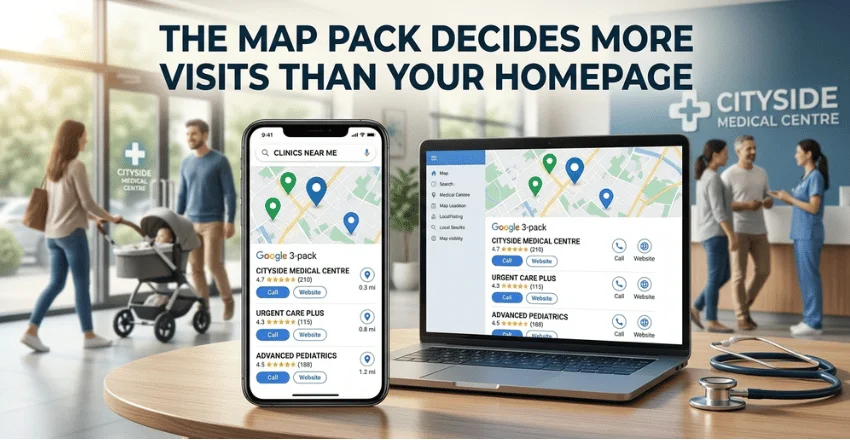
For anything with an address attached, three map results sit above the organic list. Winning them is a separate discipline from ranking a page, and multi-provider clinics routinely get the setup wrong.
Google allows more than one profile per practice. The practice itself gets a profile at its address. Each public-facing practitioner may also hold their own profile at that address, ideally with a direct phone line. Support staff do not get one. Departments inside a larger facility can hold their own profile when they run separate hours or a separate entrance.
Then keep it fed:
- identical name, address and phone details on every directory that lists you
- a booking or telehealth link on the profile itself, not just the site
- services listed one by one instead of lumped into the description
- Photos of the entrance, the waiting area, and the parking, because patients look for those
- reviews requested from every patient and never incentivised, since Google prohibits paying for them
One warning worth taking seriously. Unverified medical claims on a profile are a suspension risk, and a suspended profile can take weeks to get back.
What you are not allowed to say
Here is where healthcare SEO parts company with every other industry. Your marketing copy is regulated in three directions at the same time.
Under 45 CFR 164.508(a)(3), the HIPAA Privacy Rule requires written patient authorization before protected health information is used for marketing. Limited exceptions apply. That guidance has stood since 2003. The same page states that a practice may not sell patient lists to a third party at all. So a testimonial campaign pulled from your chart data needs signed authorizations first.
The FTC expects advertising claims to be substantiated before they run, not after somebody complains. State medical boards then add their own advertising rules, and those differ from state to state. Words like cure, guaranteed, painless, and best in the city are the ones that attract attention.
Write the outcome instead of the promise. “Most patients return to desk work within five days” is checkable. “Painless recovery” is not.
Measuring patients without leaking their data
Analytics on a medical site is an unsolved problem at most practices. Configured carelessly, a tracking pixel on a condition page can hand a visitor’s IP address and the topic they were reading to an ad platform.
Regulators pushed hard on this. OCR guidance issued in 2022 told covered entities that such combinations could amount to protected health information. A federal court vacated part of that bulletin in June 2024, and the agency dropped its appeal two months later. The pressure did not vanish with it, because state privacy law and private lawsuits still apply.
Most practices land somewhere like this:
- keep third-party advertising pixels off condition pages and off anything behind a patient login
- use first-party or server-side measurement on those templates instead
- switch off any feature that writes a full page URL into an ad platform
- Get a business associate agreement signed before a vendor touches anything patient-facing
What healthcare SEO costs, and when it pays

| Single location | $1,000 to $3,000 | Month 4 to 6 | Profile work, two to four reviewed pages a month, citation cleanup |
| Multi-location group | $3,000 to $8,000 | Month 5 to 8 | Location pages, provider profiles, technical fixes |
| Hospital or health system | $8,000 and up | Month 8 to 12 | Service line strategy, migrations, in-house clinical review |
Those are US market rates, and they move with the specialty. Dermatology and orthopedics practices in a large metro area are the hardest, because hospital systems with in-house teams already hold page one. Rural family practices can see movement in eight weeks.
What AI Overviews changed for patient questions
Symptom queries are exactly the ones Google now answers on the results page. Someone asking what causes a sore jaw often reads a summary and never clicks anything.
So chase the queries that still need a human answer. Cost, insurance networks, appointment availability, what happens on the day, who the surgeon is, whether you accept a specific plan. Those convert, and no generated summary can answer them on your behalf.
The clinical side of search is shifting too. Evidence tools built for doctors, such as Open Evidence AI, now sit between a physician and the literature. Referring clinicians are part of your audience, and they read differently from patients.
Your first 90 days
- Claim the practice profile, then add one for each public-facing provider.
- Correct the name, address, and phone details on every directory that already lists you.
- Give every existing service page a named clinical reviewer and a review date.
- Audit the site for advertising pixels on condition pages, then remove them.
- Publish two condition pages a month, written for the question and reviewed by a clinician.
- Ask satisfied patients for reviews with a sign at the desk, never with an incentive.
Start with the cheapest fix.
Open your five busiest service pages. Add a named clinical reviewer and a review date to each one. Then check whether any of them carry an advertising pixel and pull it if they do. Do that before you commission another article. Then get a quote from an agency that can show you medical clients and a written compliance process, not just a ranking chart.
FAQs
It includes local SEO and then adds a compliance layer. You still fight for the map pack. You also carry evidence standards and privacy limits that a restaurant never meets.
No. Writers can draft, provided a named clinician reviews and approves the content and the page names. Review is the part Google’s raters can see.
Only with written authorization, and some state boards restrict them further even then. Google reviews sit with the patient, which is why they are safer ground than testimonials you collect and republish.
One page per condition you treat, one per procedure, one per location, plus provider bios. Most practices need forty to sixty pages before content volume stops being the limiting factor.
Yes, if the posts answer questions patients ask before booking. Generic wellness posts do very little now. Recovery and cost questions still bring people to the phone.