
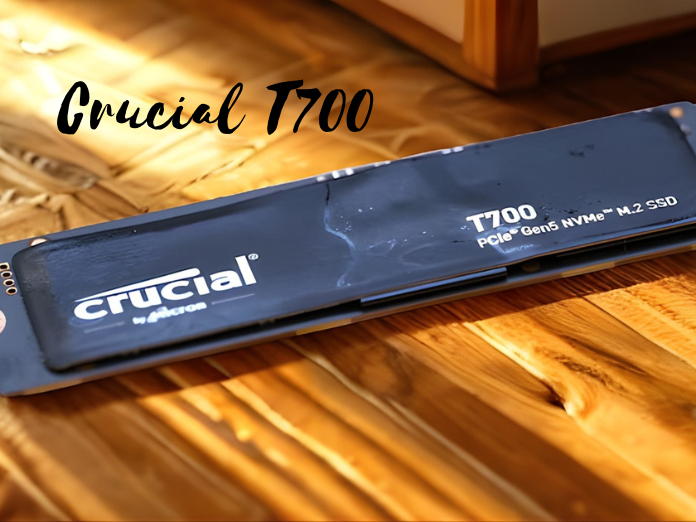
The Crucial T700 is a high-performance PCIe 4.0 NVMe SSD designed for users seeking fast file transfers, quick game load times, and smooth media editing workflows. Combining Micron’s advanced TLC NAND with a robust controller, the T700 balances speed, reliability, and value, making it suitable for gamers, content creators, developers, and everyday users.
With options for multiple capacities, integrated heatsinks, and firmware optimizations, the Crucial T700 delivers responsive real-world performance while maintaining thermal efficiency and durability across diverse workloads. While the T700 targets high-end use cases, it also offers models and capacities that make it viable for power users seeking a balance of cost and performance. There is more on this in Paid Search Services.
| Section | Key Points |
| Interface & Form Factor | M.2 2280 NVMe PCIe 4.0 x4; backward compatible with PCIe 3.0. |
| NAND & Controller | Micron TLC 3D NAND; modern NVMe controller with LDPC, SLC caching, wear leveling. |
| Cache & HMB | DRAM cache or Host Memory Buffer for consistent performance under load. |
| Thermal Management | Integrated heatsinks and firmware optimizations for temperature control. |
| Capacities & Variants | 512GB to 4TB, with heatsink and retail/OEM options. |
| Performance | Sequential reads up to ~7,000 MB/s; high random IOPS; fast boot and app launches. |
| Endurance & Reliability | TBW varies by capacity; includes ECC, power-loss protection |
| Compatibility | Requires M.2 NVMe slot; full Gen4 speeds on supported AMD/Intel platforms; check laptop clearance. |
| Firmware & Software | Tools for firmware updates, SMART monitoring, and secure erase. |
| Warranty | Typically, 5 years; coverage depends on proper use. |
| Target Users | Gamers, content creators, developers, and everyday users are seeking faster performance. |
| Maintenance | Keep firmware up to date, maintain free space, enable TRIM, and monitor drive health. |
| Use Cases | Gaming, video editing, 3D rendering, virtual machines, and general computing. |
| Comparison | Competitive PCIe 4.0 SSD; advantage in Micron NAND, price/performance balance. |
| Conclusion | High-performance, reliable NVMe SSD with multiple capacities, heatsink options, and real-world versatility. |
Crucial T700
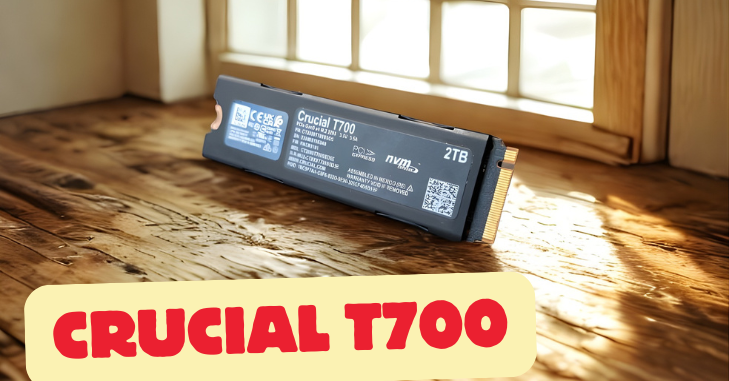
The Crucial T700 is designed to sit squarely in the high-performance NVMe category, offering PCIe Gen4 x4 bandwidth to leverage the faster interface available on modern motherboards and platforms. Crucial markets the T700 to those who need quick file transfers, fast game load times, and reduced bottlenecks in media editing workflows.
The design philosophy centers on pairing Micron’s advanced NAND with robust controller technology to deliver a competitive product at a price point often more approachable than some premium competitors’ models.
Key features
High-Speed Interface
The Crucial T700 uses a PCIe 4.0 x4 NVMe interface to achieve high sequential and random throughput, catering to demanding users.
Advanced NAND and Controller
The drive employs Micron’s latest-generation TLC NAND with a modern controller that supports high bandwidth, error correction, wear leveling, and garbage collection.
DRAM Cache and Host Memory Buffer (HMB)
Many T700 models include a robust DRAM cache or use HMB techniques to maintain consistent performance under sustained workloads.
Thermal Management
The T700 emphasizes thermal control, with features such as integrated heatsinks and firmware-level optimizations to maintain performance and efficiency during prolonged use.
Power and Performance Optimization
Power management features balance performance with energy efficiency, making the T700 suitable for both laptops and desktops.
Detailed Specifications

- Interface and form factor: The Crucial T700 uses the M.2 2280 form factor and supports the NVMe 1.4+ protocol over PCIe Gen4 x4 lanes. The M.2 2280 size makes it compatible with the majority of modern motherboards, laptops with M.2 slots, and many compact systems that support NVMe drives.
- NAND type and controller: The T700 generally uses Micron’s 176-layer or similar-generation TLC 3D NAND, depending on production batches and model revisions. This dense NAND offers a balance of density, endurance, and cost-efficiency. The controller is a modern NVMe controller that supports advanced features such as LDPC (low-density parity-check) error correction, SLC caching, and efficient wear-leveling algorithms.
- Performance metrics: On paper, the Crucial T700 targets high sequential read and write speeds that leverage PCIe 4.0. Sequential read speeds can approach or exceed 7,000 MB/s on higher-capacity models, while sequential writes vary by capacity and whether the drive is operating inside its SLC cache. Random I/O performance, measured in IOPS, is also strong, with high figures for both 4K read and write operations, supporting responsive system performance and fast application load times.
- Endurance and reliability: Endurance is expressed as TBW (terabytes written) and varies by capacity. Higher-capacity models naturally have higher TBW ratings because more NAND is available to distribute write wear. Typical T700 endurance ratings align with market expectations for consumer high-performance SSDs, offering adequate longevity for typical heavy consumer and prosumer workloads. The drives also include features such as power-loss protection and robust ECC to maintain data integrity.
Performance
The Crucial T700 delivers excellent real-world performance, particularly in tasks that benefit from high sequential throughput, such as transferring large files, loading game libraries, or handling video editing and 3D rendering assets. Its high random read/write IOPS enhance system responsiveness, speeding up boot times and application launches.
Performance under sustained workloads depends on the SLC cache and thermal management: while the T700 efficiently handles caching, extremely heavy continuous writes may reveal native TLC speed limits. Gamers benefit from faster load times and reduced texture pop-in in open-world games, while content creators experience smoother timeline scrubbing and shorter export times for high-resolution media.
Compatibility And Platform Considerations
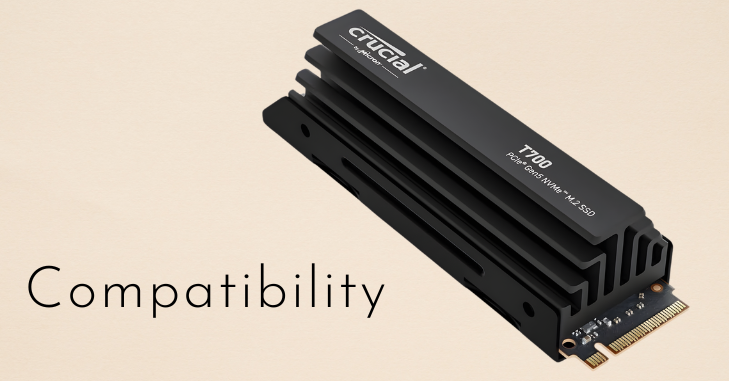
- The Crucial T700 requires a motherboard or system that supports M.2 PCIe NVMe drives.
- It is backward-compatible with PCIe 3.0 systems, but full PCIe 4.0 speeds are achieved only on Gen4-compatible platforms.
- Gen4 support is common on AMD Ryzen 3000/5000/7000-series and certain Intel 11th–14th gen CPUs with compatible chipsets.
- Users should confirm BIOS and firmware compatibility, especially on older desktops or laptops.
- Laptop users must check physical clearance and thermal constraints, particularly for models with an integrated heatsink.
- Some thin-and-light laptops may not accommodate a heatsinked T700 without modifications due to strict M.2 height limits.
Firmware, Software Tools, And Warranty
Crucial provides software utilities for drive management, firmware updates, and performance monitoring. These tools allow users to update firmware (important for stability and performance), check SMART data, and securely erase the drive when necessary. Keeping firmware up to date can resolve early-life issues and improve compatibility with newer platforms.
Warranty
This terms vary by capacity and region, but typically include a limited warranty measured in years (commonly five years for many consumer NVMe products) along with the TBW rating. Warranty coverage is contingent on proper use and may be voided by unauthorized disassembly. Users should register their product and retain purchase documentation in case an RMA is needed.
Comparisons With Competing SSDs
The NVMe market is competitive, and the T700 sits among many strong alternatives. Competing models from other manufacturers offer similar PCIe 4.0 performance, and differences often come down to price, firmware behavior, thermal design, and bundled software.
Some competitors emphasize slightly higher peak throughput, while others focus on lower temperatures or specialized caching strategies. Crucial’s advantage lies in Micron’s NAND manufacturing and in its reputation for a balance between price and performance. Prospective buyers should compare real-world benchmarks, warranty terms, endurance ratings, and thermal performance for their specific use cases.
Use Cases And Target Users
- The Crucial T700 is ideal for gamers, providing faster load times and reduced texture streaming issues.
- Content creators and media professionals benefit from shorter file transfer and export times when working with high-resolution video or large asset libraries.
- Power users and developers experience improved productivity when running virtual machines, compiling code, or handling large datasets.
- Everyday users enjoy a faster, more responsive computing experience than with SATA SSDs or slower NVMe drives, though the benefit varies by workload.
Maintenance and Best practices
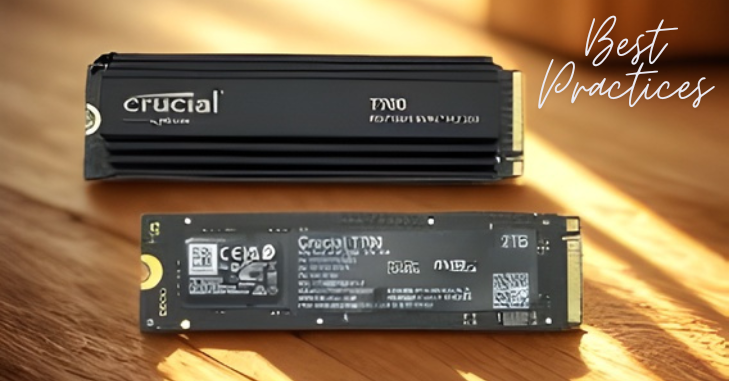
To maintain performance and longevity, users should follow best practices: keep firmware updated, ensure adequate cooling, avoid filling the drive to maximum capacity (maintain free space for overprovisioning), and enable TRIM support in the operating system. Regular backups are essential; while SSDs are reliable, no storage medium is immune to failure. Use the Crucial software tools to monitor SMART attributes and perform secure erases if repurposing or disposing of the drive.
Conclusion
The Crucial T700 is a compelling choice for users who want high-performance PCIe 4.0 NVMe storage with solid endurance, good thermal management options, and value rooted in Micron’s NAND manufacturing. It excels in demanding consumer and prosumer scenarios, gaming, content creation, and intensive desktop workloads while offering multiple capacities and heatsink choices to match system constraints.
When choosing a T700, consider your platform’s PCIe generation support, thermal environment, required capacity, and budget. Compare current market offerings and real-world benchmarks to ensure the T700 aligns with your performance and reliability expectations.
Want to know about Xbox Series S 1tb: A Complete Guide to Design, Build Quality, Check out our Tech category.
FAQs
It’s still very early in the PCI Express 5.0 game, but the Crucial T700 is the best Gen 5 SSD we’ve encountered to date. It’s offered in the highest capacity (4TB) and is available with or without a heatsink; it has 256-bit AES encryption built in; and it’s the fastest drive we’ve benchmarked so far.
The Crucial T700 4TB heatsink and the Crucial T500 4TB are both solid-state drives with the same Capacity (4000 GB) and Form Factor (M.2-2280). The main differences are in the interface, NAND Flash Type, Max Sequential Read, and Max Sequential Write.
Micron has made the difficult decision to exit the Crucial consumer business to improve supply and support for our larger, strategic customers in faster-growing segments,” said Sumit Sadana, EVP and Chief Business Officer at Micron Technology.
2 SSD. The Crucial T700 PCIe® 5.0 NVMe™ SSD offers sequential read speeds of up to 12,400MB/s and sequential write speeds of up to 11,800MB/s(up to 1,500K IOPS random reads/writes) for faster gaming, video editing, 3D rendering, and other heavy workloads.