
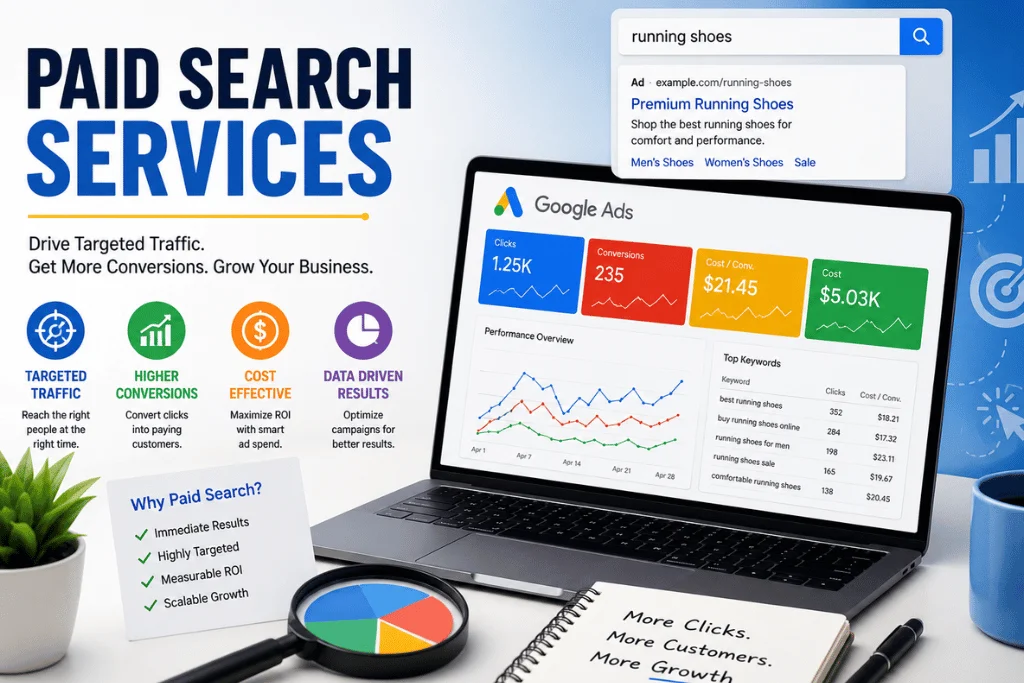
Hiring someone to run your search ads is less about the platform than about the contract. Two providers can quote the same monthly fee and sell you completely different work. The fee is the easy part. This guide covers what a Paid Search Services package includes, what each type of provider charges, and the ownership clause most buyers only read on their way out the door.
| Paid Search Services | What the market looks like in 2026 |
| Monthly management fee | $500 to $10,000 for most smaller accounts |
| Percentage model | 10 to 20 percent of ad spend, 15 percent being common |
| One-time setup or audit fee | $1,000 to $5,000, billed separately |
| Typical first contract | Three to six months, then rolling |
| Who should own the ad account? | You, always |
| Fair point to judge the results | Day 90 for the signal, day 180 for a verdict |
TL;DR
- A package is only as good as its scope document. Get the deliverables in writing.
- Four provider types exist: full-service agency, PPC specialist shop, freelancer, and in-house hire.
- Flat retainers suit stable budgets. Percentage of spend suits accounts that scale.
- Landing pages, creative production, and tracking work are usually billed on top.
- Own the Google Ads account yourself. Everything else is recoverable. That is not.
What paid search services are included?

Ask three providers for a scope of work, and you will get three different documents. The reliable ones list deliverables and a frequency. The vague ones sell you “management” and leave the definition to themselves.
A complete package normally covers:
- Account audit and strategy before anything is switched on, including a competitor scan and a target cost per acquisition.
- Keyword and query research, which starts with knowing which products carry a margin. If you sell online, finding profitable niche products sits upstream of any keyword list.
- Campaign build: search, Shopping, remarketing, and usually a Performance Max campaign with brand exclusions applied.
- Ad copy and asset writing, plus testing across headlines and descriptions.
- Bid and budget management, including the choice of bid strategy and the target attached to it.
- Conversion tracking setup and audit, because a fee spent optimizing the wrong action is wasted twice.
- Reporting and a standing call, at whatever rhythm you agree.
Three things are usually excluded. Landing page builds, creative production for display and video, and any deep tracking implementation on your site. Get those priced up front, or they arrive as change orders in month two.
Four ways to buy, and what each one costs
Provider type shapes the relationship more than the fee does, because it decides who touches your account each week and how much of their attention you actually get.
| Option | Typical monthly cost | Pros | Cons |
| Full-service agency | $3,000 to $12,000 | One team across search, social, SEO, and creative | Search can be a side dish; juniors often do the daily work |
| PPC specialist shop | $1,500 to $6,000 | Search is the whole business; deeper platform skill | No help with creative or site changes; narrow view of your funnel |
| Freelancer | $500 to $2,500 | Cheapest route to real expertise; flexible terms | One person, no cover for vacations or illness; capacity ceiling |
| In-house hire | $8,000 to $13,000 fully loaded | Full attention and deep product knowledge | $100,000+ a year; you carry the hiring risk |
Rough rule: below roughly $20,000 of monthly ad spend, a specialist shop or a strong freelancer usually beats a full-service agency on value. Above it, an agency’s bench starts to earn the premium. An in-house hire only makes sense once the work genuinely fills a week.
How the pricing models compare

| Model | How it bills | Typical range | The catch |
| Percentage of ad spend | A share of what you spend each month | 10 to 20 percent | Your provider earns more when you spend more |
| Flat retainer | Same fee regardless of spend | $1,500 to $10,000 | Scope creep goes unpaid, so service quietly thins |
| Hybrid | Base fee plus a percentage above a threshold | $1,000 base plus 8 to 12 percent | Two numbers to negotiate instead of one |
| Performance-based | Per lead, or a share of tracked revenue | Varies wildly | Whoever defines a “lead” controls the invoice. |
Percentage billing carries a real conflict. Raising your budget raises the fee, and nobody has to justify the increase very hard. Most percentage contracts also set a minimum fee floor, often $1,000 to $1,500, which makes them expensive at small spend levels.
Watch for costs that sit outside the fee entirely. Reporting dashboards, call tracking, and creative production get passed through, often with a markup. If you would rather keep creative in-house, cheap tools now cover a lot of that gap, and producing ad creative faster removes one line item from the invoice.
Who owns the account when the relationship ends
Almost nobody asks it. This is the question that costs the most when the answer turns out badly, and it never comes up in the pitch. If your provider created the Google Ads account under their own login, they own it. You can be removed from it the day you give notice. What leaves them is not just access. It is years of conversion history, audience lists, search term data, and the machine learning that your bid strategies were trained on. A fresh account starts with learning at zero.
Fixing this takes ten minutes. Create the Google Ads account under your own company email, add your own billing details, then link your provider through their manager account. They get every permission needed to run campaigns and none of the power to lock you out. Put one line in the contract: the client is and remains the sole owner of all advertising accounts and retains administrative access at all times. A provider who resists that line has told you something useful for free.
Seven questions to ask before you sign
- Who owns the ad account, and can I keep admin access from day one?
- Who does the daily work, and how many other accounts does that person manage? Past eight or ten, your account is a queue position.
- What exactly is in the fee, and what is billed on top?
- What is the notice period, and what do I keep when I leave?
- Can you show a change log from a live account, with names and dates redacted?
- What non-brand cost per acquisition do you expect by month three?
- What is your 12-month client retention rate?
- Retention is the most honest number in the room, because it reflects the judgment of people who already paid, already saw the work, and chose to stay. Above 75 percent is fine. Below it, ask why.
What good onboarding looks like
Your first quarter tells you almost everything about the next year. Watch it closely. In weeks one and two, expect access requests, a tracking audit, and a written baseline of where you are now. Weeks three and four should bring the campaign build and the first live changes. By day 60, you should be seeing tests, not just tweaks. By day 90, the account should look deliberately structured, and your provider should be able to explain every campaign in a sentence. If you are still waiting on a strategy document in week five, that pattern rarely corrects itself.
How to tell the engagement is working
Traffic growth is not the measure. Neither is a chart with an upward arrow on it.
Judge three things. First, non-brand performance: cost per acquisition on people who did not search your company name, compared against your baseline. Second, whether the explanation matches the numbers, so that a bad month comes with a cause and a fix rather than a shrug. Third, whether you could hand the account to a new provider tomorrow and have them understand it in an hour.
Ad spend is capital, and the same discipline you would apply to any other outlay applies here. If you track how efficiently each dollar works across the business, put your search program on the same footing.
The verdict
For most businesses spending under $20,000 a month, Paid Search Services from a PPC specialist shop on a flat retainer is the strongest buy. You get people whose whole job is searching, plus a fee that does not climb with your budget. The shop is also small enough that the person on your call is the person in your account.
Choose a full-service agency when the search is one channel among several, and you need the coordination. Choose a freelancer when the budget is small, and you can accept single-person risk. Hire in-house last, once the account justifies a salary. Whichever you pick, own the account.
Your next step
Before you take another sales call, write down three numbers: your monthly ad budget, your target cost per acquisition, and the most you can pay in fees. Then ask every provider the ownership question first. Answers to that one question will sort your shortlist faster than any proposal deck.
FAQ
Most small businesses pay $500 to $2,500 a month in management fees, plus the ad spend itself. Add $1,000 to $3,000 once for setup. Providers charging under $400 a month are usually running templates across dozens of accounts.
Flat fees are cleaner at stable budgets and protect you from the incentive to spend more. Percentage deals make sense when your budget swings seasonally, since the fee falls in quiet months too.
Bid strategies need conversion volume before they stabilize, so treat the first 30 days as data collection. Day 90 gives you a real signal. Day 180 is when a fair decision can be made.
Yes, and at very small budgets it often makes sense. That math changes once wasted spending exceeds a management fee, which for many accounts happens somewhere around $3,000 a month.
Nothing, if you own the account. Your new team inherits the structure, the history, and the tracking. If the old provider owned it, you start over, which is exactly why the ownership clause matters.