
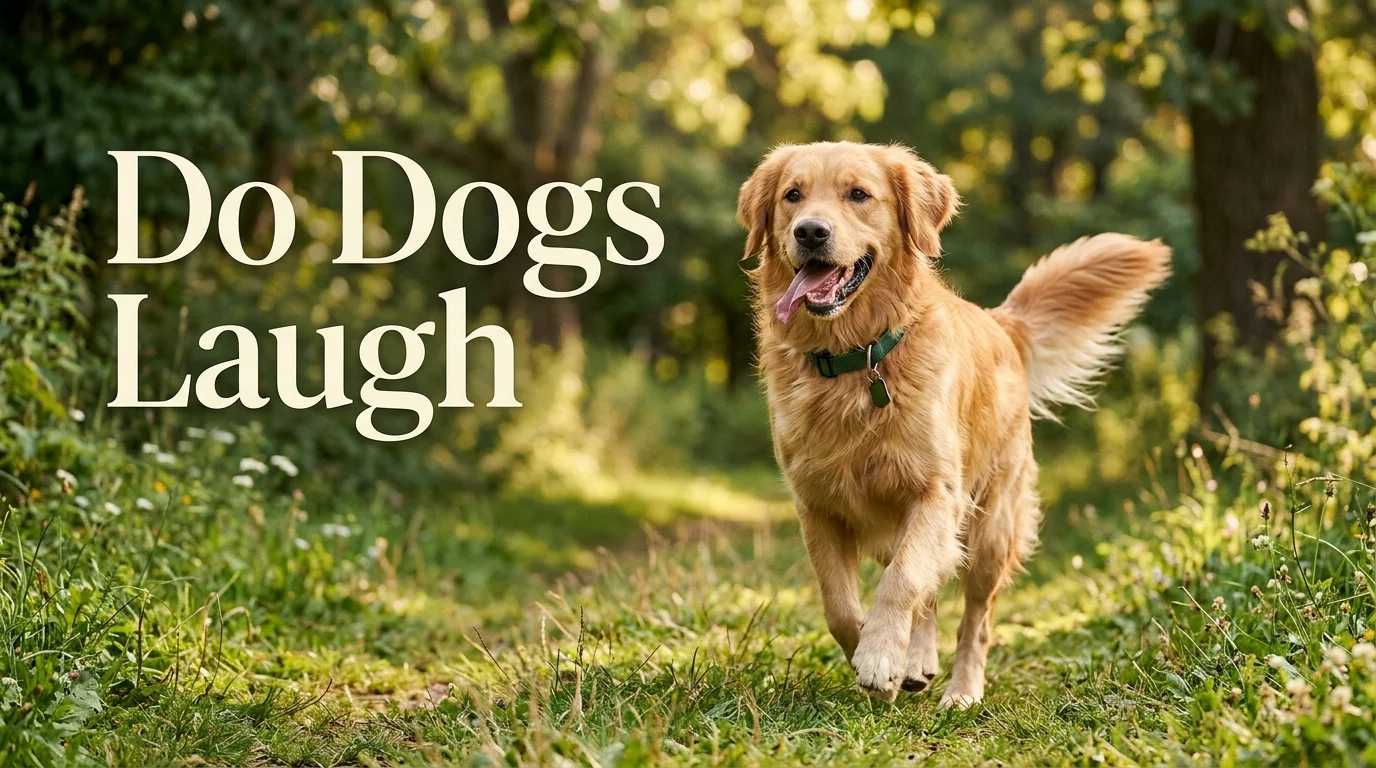
If you wonder, “do dogs laugh,” science offers a qualified yes. Canines make a distinctive play pant, a breathy exhalation heard during friendly play. Researchers consider it laughter-like, but it does not show that a dog understands jokes as humans do.
| Question | Best current answer |
|---|---|
| Closest canine equivalent to laughter | A distinctive play pant heard mainly during friendly play |
| What it sounds like | Breathy, forced exhalations rather than a voiced human-style “ha-ha” |
| Common body language | Loose movement, play bows, chasing, and voluntary re-engagement |
| What science can show | The sound is associated with play, but humor itself remains harder to prove |
| When panting needs attention | At rest, after cooling fails, or with weakness, collapse, or breathing difficulty |
Key Takeaways
- A dog’s “laugh” is best described as a play pant, not a human-style chuckle.
- A peer-reviewed 2023 study found this pant appeared mainly during play, not training or rest.
- Body language matters because ordinary panting can reflect heat, exertion, stress, pain, or illness.
- A relaxed face can look like a smile, but visible teeth do not always mean happiness.
- Sudden or heavy panting at rest deserves veterinary attention, especially with other warning signs.
Do Dogs Laugh Like Humans?
Human laughter often reflects amusement, social bonding, or both. A dog’s closest known equivalent is a play-specific pant without a spoken chuckle. That distinction matters because ordinary panting also serves cooling, exercise, stress, and medical needs.
A 2023 peer-reviewed pilot study recorded 16 human-dog pairs during training, play, and rest. Researchers found play pants were almost absent during training and rest. They appeared mainly alongside play behaviors, tickling, and cuddling.
The study supports a real, context-specific sound rather than random breathing noise. Still, the authors called their findings preliminary and encouraged more research. Science can identify a play signal more easily than it can prove a human-like sense of humor.
What Does Dog Laughter Sound Like?
To human ears, it can sound like soft, breathy panting. Earlier researcher Patricia Simonet described forced exhalations that differed acoustically from ordinary panting. You are more likely to hear them during chase, tug, or relaxed social play.
Simonet’s early findings became widely cited, although much of that work appeared in conference proceedings. The 2023 study strengthened the evidence by independently confirming a distinct play pant. That newer result gives owners a firmer scientific basis for recognizing the sound.
PetMD describes the sound as forceful panting used during play. Purina US also links play panting with invitations to interact. Both sources stress that canine laughter does not work exactly like human laughter.
5 Signs You Are Hearing a Play Pant
Sound alone is not enough to identify play. Read the whole body, the activity, and what happens after the sound. A playful animal usually looks loose and keeps choosing to engage.
- The sound happens during voluntary play. It appears during chasing, tugging, wrestling, or playful greeting.
- The body stays loose. Movement looks bouncy rather than stiff, frozen, or guarded.
- You see play invitations. A play bow, pawing, or teasing approach often appears nearby.
- The animal returns willingly. It pauses, then chooses to rejoin the game without pressure.
- The sound eases when play ends. Breathing should settle as excitement and activity decrease.
Context prevents a common mistake: treating every open mouth as happiness. A tense body, tucked tail, repeated avoidance, or freezing can point elsewhere. Give your pet space when its body says the interaction is unwelcome.
Play Panting vs. Regular Panting

| Clue | Play pant | Regular or concerning panting |
|---|---|---|
| Typical context | Friendly, voluntary play | Heat, exercise, stress, pain, or illness |
| Body posture | Loose, bouncy, socially engaged | May look tired, tense, or distressed |
| What happens after rest | Usually fades as play stops | May continue despite rest or cooling |
| Main question | Is this a social play signal? | Why is my pet breathing this way? |
| When to seek help | Usually unnecessary for normal play | Urgent with collapse, weakness, or breathing difficulty |
Normal panting after exercise can be expected, especially in warm weather. Heavy panting at rest or worsening breathing deserves more attention. The American Kennel Club lists breathing difficulty, collapse, and abnormal gum color among urgent warning signs.
Other symptoms can change the picture, too. Writina’s dog vomiting guide explains warning signs when panting appears with repeated vomiting. Its bed bugs versus fleas guide can also help when scratching and household pests complicate behavior.
Does a Play Pant Mean Your Dog Is Happy?
A play pant is best read as a positive social signal within friendly play. It often appears with play bows, chasing, loose movement, or affectionate contact. That makes it useful evidence of engagement, not a complete emotional diagnosis.
Emotions are harder to prove than behaviors. Researchers can measure when a sound appears, its acoustic features, and another animal’s response. They cannot ask a dog whether it felt something identical to human amusement.
This distinction keeps the science useful without draining the fun from the observation. Your companion may be enjoying the game and signaling friendly intentions. Calling the sound laughter-like is accurate, while claiming human-style humor goes beyond current evidence.
Can Dog Laughter Calm Other Animals?
Simonet’s 2005 shelter research reported fewer stress behaviors during playback of recorded play pants. The same report noted more pro-social behaviors, including approaching and lip licking. Because the work was conference research, its results should not be treated as final proof.
Still, the finding offers a plausible reason friendly play sounds may matter socially. A laugh-like pant may tell another animal that an interaction is nonthreatening. More peer-reviewed playback studies would clarify how reliable that effect is across homes, parks, and shelters.
Can You Encourage a Play Pant?
You do not need to imitate the sound to encourage it. Create a safe, voluntary play session and let your pet set the pace. Short games of tug, chase, or toy play may bring out natural play panting.
- Choose a familiar toy or game your pet already enjoys.
- Invite interaction with relaxed movement and plenty of room to disengage.
- Pause often, then continue only when your companion clearly chooses to return.
Do not tickle, chase, or restrain a pet that tries to leave. Play should remain voluntary from start to finish. If your companion stiffens, hides, or turns away, switch to a calmer activity.
Can a Dog Smile Too?
An open mouth and relaxed face can look like a human smile. Yet facial appearance is only one part of canine communication. Soft eyes, loose muscles, comfortable movement, and context matter more than a grin alone.
PetMD notes that several canine expressions can resemble smiling. Visible teeth can also appear with submission, fear, or defensive behavior. Avoid assuming every toothy expression means the animal is happy.
Frequently Asked Questions
Do dogs laugh when they are happy?
They may produce a play pant while enjoying social play. The sound often comes with loose, friendly behavior and a willingness to keep going. It is safer to call it a laughter-like play signal than proof of human-style amusement.
What does a dog laugh sound like?
It usually sounds like breathy, forced panting rather than a voiced chuckle. The pattern can be hard to separate by ear alone. Look for playful context, relaxed movement, and voluntary re-engagement before labeling the sound.
Why does my dog huff while playing?
A huff during play may be part of a play pant, especially with loose body language. It can also be ordinary exertion-related breathing. Watch what happens after the activity stops and whether breathing returns toward normal.
Do dogs laugh when tickled?
They do not produce human belly laughter when touched. The American Kennel Club says some pets may pant or sigh during tickling. Stop immediately when the animal pulls away, stiffens, or shows discomfort.
Should I worry when panting suddenly changes?
Sudden, severe, or persistent panting deserves attention, especially at rest. Trouble breathing, collapse, weakness, or abnormal gum color can signal an emergency. Contact a veterinarian promptly when breathing looks labored or your pet cannot settle.
The Bottom Line
The best scientific answer is careful rather than cute. A dog can make a distinctive play pant that functions much like laughter. Current evidence supports a real play signal, but not proof of joke-based human humor.
Watch the sound together with posture, movement, and context. That approach helps separate playful panting from stress, heat, or illness. Browse Writina’s latest practical guides for more useful pet and everyday explanations.